
Retail investors usually get caught up in the frenzy of a bull market and burn their fingers in IPOs, warns Tinesh Bhasin.


Gold prices fell to a 5-year low of less than $1,100/ounce.
A year on, the outlook is much more positive. In 2010, public sector players, which have done a bulk of the lending over the last 15 months, are going to strengthened with the government set to start the Rs 15,000-crore recapitalisation programme.

Banks get bonds boost to raise funds for core sector; up to Rs 50 lakh of home loans in metros and Rs 40 lakh in other cities not to have CRR, SLR requirements

They also have to reveal terms and conditions for loans, credit cards.
Company is looking to raise the funds through dollar-denominated loans.

Investors looking for a fixed-income product that is free of credit risk may invest in these bonds.

Bank of Baroda Q4 results: Key brokerages have raised their target prices on Bank of Baroda after the state-owned lender posted better-than-expected March quarter (Q4FY23) results. Analysts now see up to 29 per cent upside in the stock from a one-year perspective as they believe BoB is well-placed among the large public banks with nearly all key business metrics moving closer to the top-tier banks. Valuations, too, remain attractive despite steady strong quarterly performances.

There is so much liquidity in the system, in the global economy, and that's why the stock market is very buoyant. It will certainly witness correction in the future: RBI's Das.

If they are made accountable, bad loan cases will shrink dramatically, recoveries will rise, and the NCLT process will be more manageable, asserts Debashis Basu.
With rising interest rates and inflation taking a toll on home loan customers, banks are beginning to encourage them to partly prepay their loans. Many of them are doing so without charging them prepayment penalty.

...benefiting 350,000 persons. Also, Trai detected and blocked seven million mobile phone connections involved in cyber fraud and suspicious activities.
Public sector banks have suddenly developed cold feet on raising lending rates even if it means sacrificing on their bottom lines.
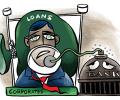
While IDBI Bank's 140 million customers and 1800-odd branches will come in handy for LIC to hawk insurance, the bank can use LIC's massive agent network to sell its retail loans. But if it is run the same way it had been in the past and LIC is a proxy of the government, then it has no future, says Tamal Bandyopadhyay.

Mortgage lender HDFC Ltd on Friday hiked its lending rate by 50 basis points hours after the Reserve Bank raised the benchmark interest rate to tame inflation. The move would increase EMIs for housing loans by the firm. "HDFC increases its Retail Prime Lending Rate (RPLR) on Housing loans, on which its Adjustable Rate Home Loans (ARHL) are benchmarked, by 50 basis points, with effect from October 1, 2022," the country's biggest housing finance company said in a statement.

After the Reserve Bank of India (RBI) raised key policy rates by 25 bps in the third quarter review of monetary policy, banks have started raising lending and deposit rates.
At the start of 2008, Manoj Singh headed Tranzact Consolidated India, among the largest direct sales agents in Mumbai with about 200 employees.

'We have already sanctioned loans worth over Rs 3,000 crore to around 120,000 customers.'
The country's largest private sector lender, ICICI Bank, on Thursday slashed its benchmark lending rate by 50 basis points to 15.75 per cent, a move that would benefit the bank's home, auto, consumer and corporate loan borrowers.

The biggest bounce is in the realty sector, where the industry index jumped 80%. There's been a turnaround also in automobiles and ancillaries (up 45%). The pharma and health care indices have a welcome return of roughly 35%.

Corporate indebtedness is now twice what it was before the global financial crisis; banks' bad loans ratio is 3.5 times higher.

It takes a longer time to avail of these loans, owing to tight due-diligence process of banks.

Retail inflation declined to an 18-month low of 4.7 per cent in April mainly due to falling prices of vegetables, oils and fats, and came closer to Reserve Bank's target of 4 per cent, showed government data released Friday. It was for the second month in a row that Consumer Price Index (CPI) based inflation remained within the RBI's comfort zone of below 6 per cent. The government has tasked the central bank to ensure retail inflation remains at 4 per cent with a margin of 2 per cent on either side.

Festive season is the mainstay of most brick and mortar retail chains.
Banks are ruling out an immediate hardening of interest rates and will wait for cues from the Reserve Bank of India before effecting any changes. Most bankers said that unlike last time when inflation was above 6 per cent, the government this time has a bigger role to play than the Central bank since most price pressures are emanating from rising food and metal prices.

S&P Global Ratings on Wednesday said Indian banks face a systemic risk as the second COVID wave will impair the performance of financial institutions in the April-September period. Stating that economic recovery remains highly vulnerable to setbacks due to COVID, particularly if fresh outbreaks trigger new lockdowns, S&P said the banking sector's weak loans will likely remain elevated at 11-12 per cent of gross loans in the next 12 to 18 months. "The second wave has front-ended weakness in asset quality," said S&P Global Ratings Credit Analyst Deepali Seth Chhabria. "Financial institutions face a strained first half amid weak collections and poor disbursements."

Reliance Industries Ltd on Friday reported an 11 per cent drop in its June quarter net profit largely due to weak oil-to-chemical (O2C) vertical and higher interest and depreciation cost. Net profit was Rs 16,011 crore, or Rs 23.66 per share, in April-June - the first quarter of current 2023-24 fiscal year - compared with Rs 17,955 crore, or Rs 26.54 a share, earning a year back, according to a company's stock exchange filing.
Banks had raised the interest rates on loans by as much as 350 basis points although the cost of deposits had increased by a maximum of 200 basis points. With the deposit rates having softened from the April 2007 levels, banks have decided to pass on the benefits but only to the new borrowers.

The headline for corporate profit growth has been very encouraging in the July-September quarter (Q2) of 2023-24 (FY24), with the combined net profit of listed companies up by 38 per cent year-on-year. However, the earnings distribution has been very lopsided, with most of the growth coming from public-sector oil-marketing companies (OMCs), banks, non-bank lenders, automobile (auto) companies, and cement producers. By comparison, companies from information technology services, fast-moving consumer goods (FMCG), retail, and consumer durables were disappointed, experiencing a sharp slowdown in net sales growth and a relatively muted increase in reported net profit.

Banks, the biggest component of the Indian equity market, are now trading at a big discount to the benchmark indicesThe BSE Bankex index, which tracks the share price of the 10 top listed banks, is trading at a trailing price to earnings (P/E) multiple of 15.3X, nearly a 40 per cent discount to the BSE Sensex current P/E of 24.37X. This is the biggest valuation gap between the two indices in at least 10 years. Similarly, the BSE Bankex price to book ratio (P/B) of 2.22X is 40 per cent lower than the current Sensex P/B ratio of 3.61X.

Polarisation in the performance of Indian banks will persist as many large public sector banks are still saddled with weak assets, high credit costs, and poor earnings, S&P Global Ratings said on Thursday. It said State Bank of India and leading private sector banks have largely addressed their asset quality challenges, and their profitability is improving more sharply than the banking system. In its Global Banking Outlook-2023 report, S&P said economic recovery is driving credit costs to cyclical low levels and stronger balance sheets and higher demand should boost bank loan growth, but deposit growth will lag.

In an indication of easing financial stress among borrowers, the number of unsuccessful auto-debit requests through the National Automated Clearing House (NACH) platform declined in July, reversing a three-month trend that started with the second wave of the Covid-19 pandemic. According to the NACH data, of the 86.4-million transactions initiated in July, 33.23 per cent, or 28.7 million transactions, failed, while 57.7 million were successful. Compared to June, this is a significant improvement in bounce rates.
The bank has 1.8 lakh customers with no-frills accounts, which provide basic banking services without the need to maintain a large minimum balance.

We have millions of newbie investors who are clueless about how to handle sudden and severe adverse market reactions, which arrive from time to time, observes Debashis Basu.
The country's second largest lender ICICI Bank on Tuesday said it has not raised home loan rates from August 1 and will take a view only if cost of funds goes up.

'I don't think we have ever seen such alignment of everything that we need in the banking sector.'

Chanda Kochhar, who was arrested for a cash-for-loan scam on Friday, was once a powerful banker and instrumental in making ICICI Bank the country's biggest private sector lender. Kochhar, a regular feature on Forbes top global honchos lists, was arrested by the Central Bureau of Investigation (CBI) along with her husband Deepak Kochhar in connection with alleged cheating and irregularities in loans sanctioned by ICICI Bank to Videocon Group companies. Kochhars were called to the agency headquarters and arrested after a brief questioning session. Her chapter at ICICI Bank ended abruptly in 2018 when the board of directors approved a request from Kochhar to seek early retirement following allegation of corruption and quid pro-quo while extending loans to the now bankrupt Videocon Industries.
